
Strategic foresight for marketing and strategy teams
You can't see what's forming in your market. We can.
A Competitive Horizon Scan watches the conditions forming offshore: competitors repositioning, entrants gathering, customers drifting. Every signal cited, dated, and graded, delivered in three weeks, early enough to dodge the storm or catch the opening before your competitors do.
No pitch. We confirm fit and which questions matter most to you.
What you cannot see is what costs you
By the time a market shift shows up in your dashboards, it has already made landfall. But it was forming for weeks: the competitor quietly repositioning, the new entrant gathering strength, the substitute pulling your customers away. Most teams find out a quarter too late, from a number that already moved.
The OECD and World Economic Forum have recognized AI-augmented strategic foresight as an emerging discipline. A Competitive Horizon Scan is how Magma practices it: AI scans at scale, a senior human owns every judgment, and every finding is cited, dated, and graded.
What you get
A six-lens landscape of your market: the horizon scanning, competitor analysis, competitive landscape analysis, and market intelligence your team would otherwise source separately, in one scan. Every finding is cited, dated, and graded for how much weight it can bear, so your team can act on it with confidence.
Where your category stands today
The state-of-play baseline the other five lenses orbit.
Direct competitors
Moves, launches, positioning shifts.
Substitutes
What buyers use instead of the category.
Emerging entrants
Who is new and gaining ground.
Adjacent disruption
The category-jump threats forming at the edges.
Customer pain
The complaints and unmet needs moving right now.
It ships agent-ready too: clean, dated context chunks your own AI tools can read directly, with no slide deck to extract first.
Every finding carries an honesty grade
So you always know how much weight a claim can bear:
PROCEED
Well-sourced. Act on it.
CAVEAT
Directional. Treat as a lead, not a fact.
REFUSE
Not enough evidence to make the claim, so we tell you so. You get what you need to hear, not what you want to hear. That is the difference between intelligence and flattery.
Every finding you can defend to your board
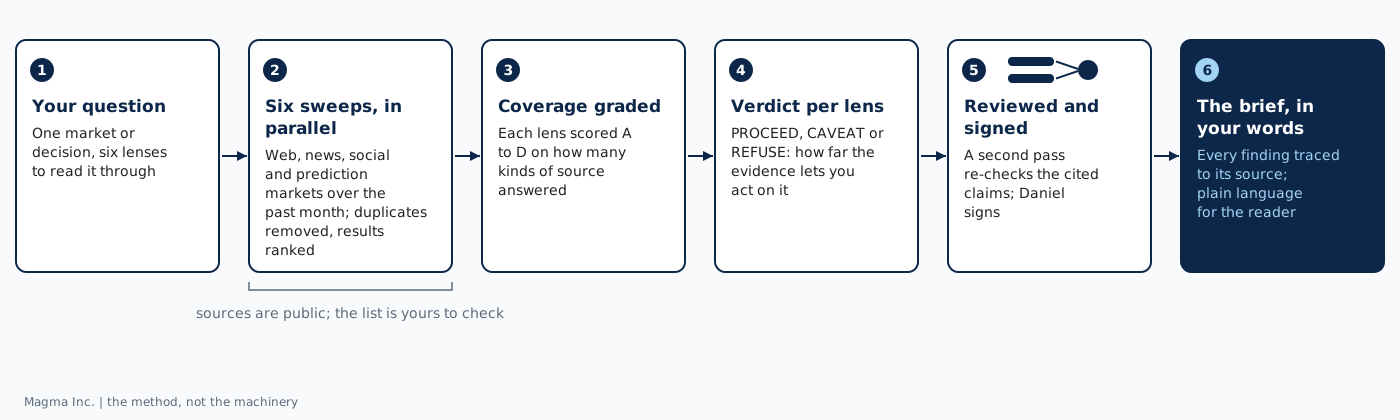
We choose from more than twenty public sources across ten kinds to fit your question: social platforms and forums, video, prediction markets, web search, news and trade press, search-demand data, research papers, company hiring boards, customer reviews, and developer activity. We read official statistics, regulators and central banks directly. Documents you hand us can be added within the scope agreed before work begins. Custom source connections and connections to your internal systems are separate work, scoped and priced as a Forward-Deployed AI engagement, with data access and security agreed with your IT team before it begins.
A search finds sources. The other steps turn them into a call you can defend to your board.
How the engagement works
A delivered three-week project, not a black-box report. It follows the Double Diamond: open up to explore, then narrow to decide, twice.
Discover and Define
Short interviews with your stakeholders to map what good looks like to you: your aspirations, your fears, the decisions this needs to inform. I converge that into the precise questions the scan will answer.
Develop
I run the six-lens scan across public, dated, authoritative sources, and grade every finding before it ships.
Deliver
A synthesis of what matters, then a walkthrough where I take your team through the findings and we agree your next moves. You finish understanding it, not holding a report you have to decode alone.
Questions a scan can answer
The method stays the same and the question changes: bring the decision in front of you, and we point the method at it.
What is forming in our category that our dashboards will show a quarter too late?
Who asks: A marketing or strategy leader new in the role.
You get a six-lens landscape of competitors, substitutes, entrants and customer pain, with each lens graded for how well the evidence supports it.
Where are travellers no longer going, and where are they going instead?
Who asks: A strategy team at a travel or tourism business.
You get which destinations are holding, which are new, and which leads are not yet strong enough to act on.
Is the per-seat model we resell about to be repriced?
Who asks: A commercial lead at a contact-centre reseller or integrator.
You get a seat-economics read that separates buyer demand from customer noise, names the competitors your current tracking misses, and marks where the evidence is thin.
Should our 2027 plan assume the US tariff on Canadian steel and aluminum stays where it is?
Who asks: A treasurer or strategy director at a manufacturer that ships metal to the US.
You get where the public forecasts agree and where they disagree, and the one assumption in your plan that is worth testing first.
Nearest sample: the steel and aluminum watch.
What will regulators and auditors expect us to show about our AI?
Who asks: A risk or governance lead at a bank or insurer.
You get a graded read of what supervisors, auditors and peers are publishing, so your answer starts from the public record.
Nearest sample: the AI uncertainties watch, signed 2026-11-03.
Which outside assumptions should the IC memo name as contested?
Who asks: A corporate development or deal-team lead.
You get the sector's public assumptions where sources disagree, and which sources sit on each side, so the memo states the uncertainty while the underwriting stays yours.
Nearest sample: the steel and aluminum watch. Sector-level only, never a named target: no material non-public information received or requested.
Which consensus views in our scenarios are robust, and which are fragile?
Who asks: An economist at a pension fund.
You get a named assumption to test, which outside forecasts support it and which do not, without prescribing an allocation.
Every one of these runs on public sources, with every finding cited and dated, at the same price per tier. Only the question changes. See the tiers below.
Investment
The free samples answer a public question we choose. The Scan answers yours, and documents you hand us can be added within the scope agreed before work begins; The Decision adds a session where your team agrees its top three moves; The Watch adds twelve issues a year on your market, each one you can quote to your board. Custom source connections and internal system integration are priced separately from these tiers.
The Scan
One question, read and signed by Daniel. A brief your board reads in two minutes, every finding cited and dated, with its sources in files your own AI tools can read. Delivered with a walkthrough, then 14 days of written answers.
The Decision
Everything in The Scan, plus:
- •A facilitated decision session: we pressure-test the findings with your team and agree your top three response moves.
- •A written, board-ready action brief you can take straight to leadership.
- •A second full scan 30 days later, so you see what moved, not just a snapshot.
The Watch
Everything in The Scan, plus a living watch on your market: twelve issues a year, each one you can quote to your board, with an alert whenever something material moves, so you see what matters while you can still act. Billed monthly or quarterly.
Not another forecaster. The service that tells you which forecasters disagree, how badly, and whether that changed since yesterday, so you know how much to trust the umbrella.
See a sample first: the steel and aluminum watch, or all the samples.
Written answers. Each paid Scan includes 14 calendar days from delivery to send written questions about its findings, each answered within two business days. New research and implementation are scoped separately.
14-day decision guarantee
If the brief does not give you one decision you can act on, tell us within 14 days of delivery and we refund the fee. You keep the brief.
Applies to The Scan and The Decision. No conditions, no small print.
Start at any tier and scale up. Upgrade within 30 days of delivery and the full amount carries over, so you are never locked into where you began.
For context: a scoped strategic-foresight or strategic-planning engagement is typically priced from $12,000 to $45,000. A single Competitive Horizon Scan delivers that at or below the floor of the range, with every finding cited and graded. Building the same watch in-house means a competitive analyst at $120,000 to $200,000 a year fully loaded, plus the hiring, training, and keeping. The Watch gives you continuous early warning at a fraction of either, as a service you switch on rather than a role you have to fill.
Why Magma, and Daniel
Magma is led by Daniel Zivkovic: working at the intersection of marketing and enterprise architecture since 1996, the rare person who reads both the market signal and the systems that turn it into action.
He is the current architect-in-residence on the agentic-marketing systems of a Fortune 500 financial-services company.
He founded Serverless Toronto, a practitioner community he has run for eight-plus years, with a long public archive of teaching.
Every engagement is led by Daniel himself, the senior principal who owns the judgment, never handed off to a junior team. Vetting him takes one click, at the bottom of this page.
See the storm before it reaches your market.
The shifts that will reshape it are forming now. A 30-minute call confirms whether strategic foresight can surface them while you can still act. If it fits, your first scan lands within two to three weeks.
A straight answer, not a sales pitch.